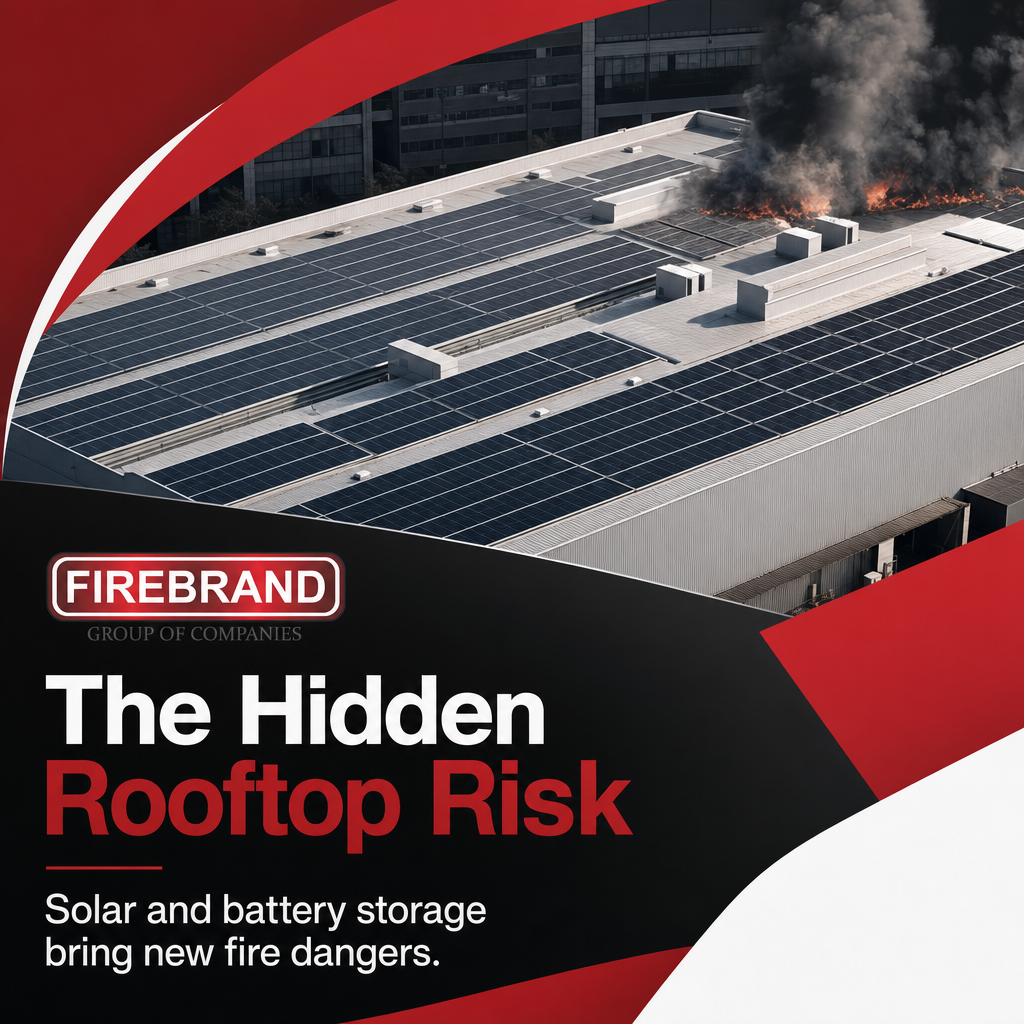
## The Energy Solution That Brought a New Problem
Load shedding pushed South African businesses to act. Across the country, warehouse roofs, office parks, and factory yards now carry solar panels and battery banks that were not there five years ago. It made sense. Grid instability was costing companies money, spoiling stock, and stalling production. Solar and battery energy storage systems (BESS) offered a way out.
What almost nobody stopped to consider was the new fire exposure that came with them. A rooftop full of panels and a room full of lithium-ion batteries are not the same as the electrical installation your building was designed around. They introduce hazards that most fire protection setups were never built to detect, contain, or survive. If your site added solar or storage in the last few years, there is a good chance your fire risk profile changed and your protection did not keep up.
## Why a Battery Fire Is a Different Beast
A traditional electrical fire is something firefighters understand well. Cut the power, remove the fuel or the oxygen, and you starve it. Battery energy storage does not follow those rules.
When a lithium-ion cell fails, it can enter what is called thermal runaway. The cell overheats, which triggers a chemical reaction, which produces more heat, which spreads to the next cell, and the next. The battery essentially becomes its own fuel and its own oxygen source. You cannot smother it the way you would a conventional fire, and cutting the power does not stop a reaction that is already self-sustaining.
That behaviour has a few consequences that site owners rarely appreciate until it is too late:
- **Reignition is common.** A battery fire that appears extinguished can flare up hours later once a neighbouring cell reaches its failure point. - **The gases are toxic and explosive.** Thermal runaway vents flammable, poisonous gas long before visible flame appears. In an enclosed room, that gas can build up and ignite. - **Standard suppression may not be enough.** Water helps with cooling, but the volume and method required are very different from what a typical sprinkler head delivers.
We covered this in more detail in [RELATED_ARTICLE], but the short version is simple. A lithium battery fire needs different thinking, different detection, and a different response plan than the fire systems most commercial buildings were designed for.
## Placement Is Half the Problem
Where these systems sit matters as much as what they are. And placement decisions are usually made for convenience or cost, not fire safety.
Solar panels tend to end up on rooftops, which puts a live electrical array directly above your operations. If a roof fire starts, the panels keep generating current in daylight, which complicates how firefighters can approach the structure. Access routes, isolation points, and clear labelling become genuine life safety issues rather than paperwork.
Battery systems are often tucked into whatever space was available. A storeroom, a plant room, a container in the yard, or a corner of the warehouse. The trouble is that batteries need ventilation, temperature control, and separation from people and stock. A BESS installed in a poorly ventilated room, or wedged against a wall shared with an occupied space, turns a contained incident into a building-wide emergency.
Some questions worth sitting with:
- Is the battery installation separated from areas where people work or where stock is stored? - Can the system be safely isolated, and does everyone on site know where and how? - Is there adequate ventilation to disperse vented gas before it accumulates? - If the battery room caught fire, what else is in the blast and smoke path?
Installers focus on generation and storage performance. That is their job. Fire containment is rarely part of the brief, which is exactly how these gaps appear.
## The Questions Site Owners Should Be Asking
Whether you are still planning an installation or you have been running one for years, the same set of questions helps surface risk that has been sitting quietly in the background.
**Before installation:**
- Has anyone assessed the fire risk of the specific battery chemistry being installed? Not all lithium batteries behave identically. - Is the proposed location suitable for a system that can vent gas and generate its own heat? - Does the design include detection capable of picking up thermal runaway early, ideally before flame? - Is there a suppression or cooling strategy matched to battery fires specifically, not just a nod to existing sprinklers? - Have isolation, access, and signage been planned so that an emergency response is actually possible?
**After installation:**
- Does your current fire protection system account for the solar and battery infrastructure, or was it designed before any of it existed? - Has your insurer been informed, and do the terms still hold given the new exposure? - Are your staff trained on what a battery incident looks like and what not to do? - When was the installation last inspected by someone assessing it through a fire safety lens rather than an electrical one?
Most sites that added energy storage did so quickly, under pressure, during the worst of load shedding. Speed was the priority. That is understandable, but it means a lot of installations were never reviewed for fire risk at all. If yours is one of them, the honest answer to several of these questions is probably "I don't know," and that is worth fixing.
## What Good Protection Actually Looks Like
Protecting a site with solar and BESS is not about buying one more extinguisher. It is about matching your fire strategy to the hazards you now have on the premises.
That starts with detection built for the way batteries fail. Early gas and thermal detection buys the one thing that matters most in a battery incident, which is time. It also means designing suppression and containment around thermal runaway behaviour, planning for reignition, and making sure the room, the ventilation, and the separation from people all work together rather than against each other.
Just as important is the response plan. Everyone on site should understand that a battery fire is not a fire to fight with a hose and instinct. It is a fire to isolate, evacuate, and manage with the right systems already in place. The value of a fire protection system was never the hardware on the wall. It is what that hardware protects, which is lives, assets, and the ability of the business to keep running the day after.
The energy transition is not slowing down. More sites will add solar and storage, and the fire risk that comes with it will keep growing quietly until it is either addressed or discovered the hard way. The businesses that get ahead of this now are the ones treating their new energy infrastructure as a change to their risk profile, not just an upgrade to their power supply.
If your site has installed solar or battery storage, or you are about to, the smartest move is to have the fire risk assessed properly before something forces the question for you. Fire Brand Group works with commercial and industrial sites across Southern Africa to bring fire protection in line with the real hazards on the ground. Get in touch today. info@firebrandsa.co.za