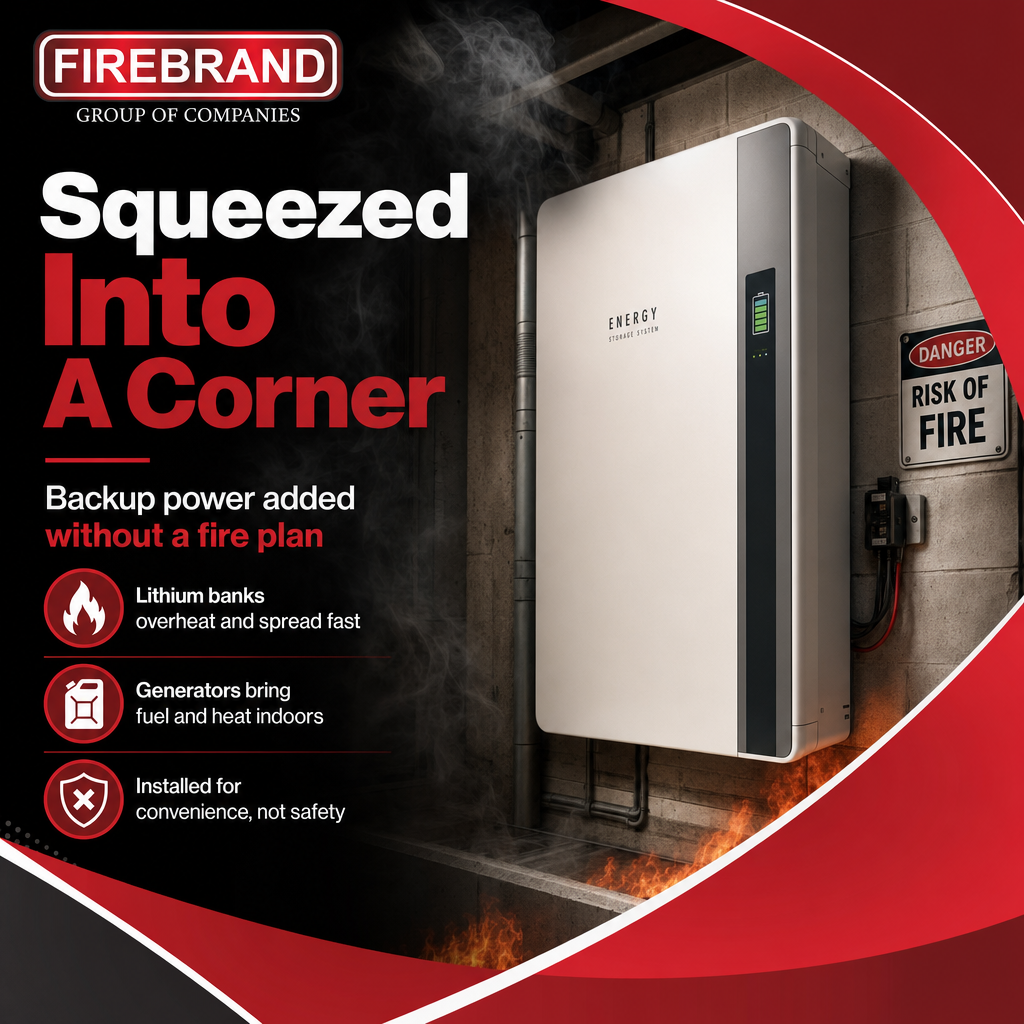
## When the Grid Fails, New Risks Switch On
Every site manager in Southern Africa has watched the same pattern play out. Load shedding hits, operations grind, and the pressure to keep things running never lets up. The answer for most commercial and industrial sites has been backup power. Generators, inverters, large battery banks, and full energy storage installations have become standard fixtures rather than nice-to-haves.
But here is the part that rarely makes it into the procurement conversation. Every one of these systems introduces fire risk that did not exist on your site before. And in many cases, that risk is sitting in a plant room, a storage container, or a wall-mounted unit that nobody has factored into the building's fire strategy.
This is not a reason to abandon backup power. It is a reason to treat it with the same seriousness as any other high-value, high-consequence part of your operation.
## Why Backup Power Changes Your Fire Profile
The rapid rollout of backup solutions happened fast, and for good reason. Reliability challenges forced businesses to act. But fire planning tends to move slower than installation timelines, and that gap is where problems live.
When a site adds a diesel generator, a bank of lithium-ion batteries, or a hybrid energy storage system, it introduces new fuel loads, new heat sources, and new failure modes. A building that was assessed and signed off years ago was never designed around any of this. The fire strategy that made sense then may no longer reflect what is actually on site.
The risk is often invisible precisely because these systems work quietly in the background. They sit idle for long stretches, then take heavy load the moment the grid drops. That cycle of dormancy and sudden demand is exactly when faults tend to surface.
## The Main Risk Areas Worth Understanding
Different technologies carry different fire characteristics. Knowing the general shape of each helps you ask the right questions.
**Battery systems and energy storage.** Lithium-ion batteries store a large amount of energy in a compact space, which is what makes them useful and what makes them dangerous when things go wrong. The concern here is thermal runaway, where a single cell failure can cascade through a battery bank, generating intense heat and gases that a standard extinguisher was never designed to handle. Overcharging, physical damage, manufacturing defects, and poor ventilation can all be triggers. These fires behave differently from conventional fires, and they can reignite well after they appear to be out.
**Generators.** Diesel and petrol generators bring fuel storage, hot exhaust surfaces, and electrical connections into one location. Fuel leaks near a hot engine, poor maintenance, or overloaded wiring all create ignition potential. Because generators are often housed in enclosed or semi-enclosed spaces to reduce noise and weather exposure, heat and fumes can build up quickly if ventilation is inadequate.
**The connections in between.** Inverters, distribution boards, cabling, and switchgear tie the whole system together. Overloaded circuits, loose connections, and undersized components are common culprits behind electrical fires. Backup installations that were added in stages, or rushed to meet an urgent operational need, are especially prone to this kind of gradual, hidden fault.
None of these risks are reasons to avoid backup power. They are reasons to design, install, and maintain it properly, and to make sure it is visible in your fire planning.
## Why These Systems Belong in Your Site Fire Strategy
Here is the core issue. A backup power system is frequently installed as an electrical project, handled by electrical contractors, and assessed against electrical standards. Fire considerations get treated as someone else's problem, or as an afterthought once the unit is already commissioned.
That approach leaves gaps. Where is the battery bank located relative to escape routes and occupied areas? What suppression is appropriate for a lithium fire versus a diesel fire? Is there adequate detection in the plant room or storage container? Can the fire service safely approach the installation, and do they know it is there? These are fire engineering questions, and they need answers before an incident, not during one.
Complex sites rarely fit a standard template. A multi-level warehouse, a facility handling lithium batteries in transit, or an industrial site running a large energy storage installation each carries its own set of variables. Off-the-shelf fire safety thinking struggles with this, which is why backup power should be assessed as part of an integrated fire strategy rather than a bolt-on. [RELATED_ARTICLE]
That integration matters more as detection and suppression systems become more connected. When detection and suppression work as one, the minutes that used to slip away between spotting a fault and acting on it get compressed. For a fast-moving battery fire, those minutes are everything.
## Practical Steps for Site Managers
You do not need to become a fire engineer to close the most obvious gaps. A few practical moves make a real difference.
- **Map what you have.** Document every backup power component on site, where it lives, and when it was added. If your fire risk assessment predates these installations, it is out of date. - **Match suppression to the hazard.** Confirm that the detection and suppression around your battery and generator installations actually suits those specific risks. A general-purpose setup is not a safe assumption. - **Prioritise location and ventilation.** Keep energy storage and generators away from occupied areas and escape routes where possible, and make sure enclosed installations have proper ventilation. - **Maintain relentlessly.** Loose connections, ageing cells, fuel leaks, and clogged ventilation are all preventable with a maintenance routine that treats these systems as fire-relevant, not just operationally relevant. - **Get a specialist review.** Have your backup power installation assessed by fire professionals who understand how these technologies fail and what containment looks like in practice.
## The Takeaway
Backup power has become essential for keeping Southern African businesses running, and that is not going to change. What needs to change is the assumption that these systems are purely an electrical or operational concern. Batteries, generators, and energy storage carry real fire risk, and that risk multiplies when it sits outside your formal fire strategy.
The sites that handle this well are the ones that treat backup power as part of the whole picture. They know what they have, they match protection to the actual hazard, and they bring in expertise before something goes wrong rather than after.
If backup power has grown on your site faster than your fire planning has kept up, now is the time to close that gap. Fire Brand Group works with commercial and industrial sites across Southern Africa to build fire strategies that reflect what is actually on the ground, backup power included.
Get in touch today. info@firebrandsa.co.za