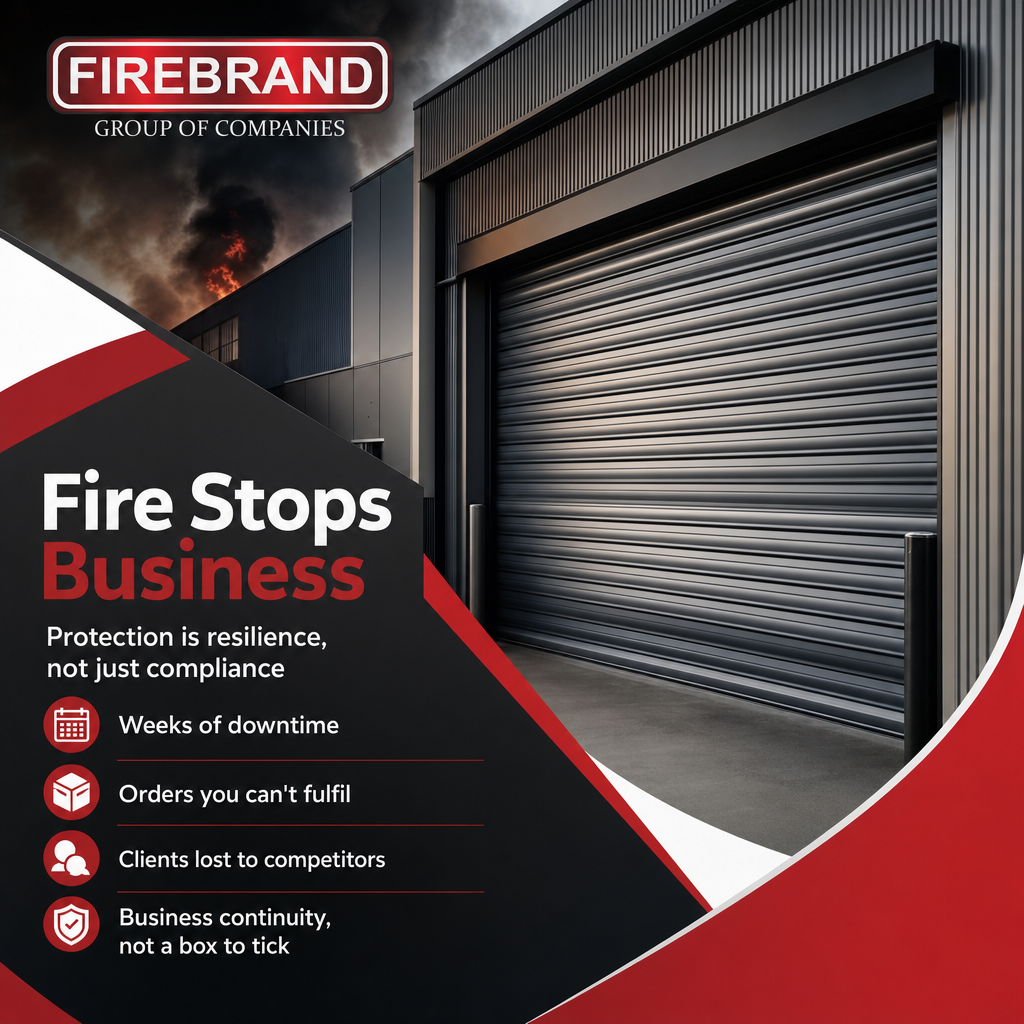
## The Real Cost of a Fire Isn't the Fire
Ask most property owners what fire protection costs them, and they will point to the invoice for extinguishers, the annual inspection, and the certificate that keeps the regulators satisfied. That is the visible cost. The far larger one sits out of view, and it only becomes real when a fire actually happens.
A fire on a commercial or industrial site rarely destroys everything. More often, it damages one section, triggers a shutdown of the whole operation, and then leaves you dealing with weeks of disruption that have nothing to do with flames. Contracts go unfilled. Staff sit idle or get laid off. Customers who were promised delivery quietly find another supplier. Insurance claims drag. The building might be repairable in three months, but the market position you built over years can vanish in a fraction of that time.
This is the gap between treating fire protection as a compliance exercise and treating it as what it actually is: a business continuity decision. One protects you from a fine. The other protects your ability to keep trading.
## Compliance Keeps the Doors Open. Continuity Keeps the Business Running.
There is nothing wrong with compliance. Meeting the regulatory bar is non-negotiable, and that bar keeps rising, especially in commercial and industrial property where scrutiny has intensified. But compliance answers a narrow question: *does this site meet the minimum legal standard?*
Business continuity asks a much sharper one: *if a fire starts here tomorrow, how quickly can we recover, and what will it cost us to get there?*
Those two questions lead to different decisions. A compliance mindset installs the systems the code requires and moves on. A continuity mindset looks at where the fire is most likely to start, what it would take out of the operation, and how the fire-safety design can limit both the damage and the downtime.
Consider a warehouse holding several weeks of stock. Compliance says fit detection and suppression to standard. Continuity says think about compartmentation, early detection, and suppression that contains a fire to one zone rather than letting it spread across the whole floor. The first approach ticks the box. The second means that when something goes wrong, you lose a corner of the building instead of the entire operation.
## Downtime Is the Number That Should Drive Your Decisions
When a site goes dark after a fire, the losses compound in ways that are easy to underestimate.
There is the direct loss of stock and equipment. Then the loss of production or trading capacity for as long as the site is unusable. Then the cost of temporary premises, if you can find them. Then the slow erosion of customer confidence, which does not show up on any repair estimate but often hurts the most.
For sites with specialised risks, the recovery timeline can stretch even further. A facility handling lithium batteries in transit, a chemical store, or a multi-level industrial site with moving parts everywhere presents a fire that behaves differently and takes longer to bring under control. These are exactly the environments where an off-the-shelf approach falls short, and where the difference between a well-engineered system and a merely compliant one is measured in weeks of lost operation.
The question worth putting to yourself is simple. If this site stopped operating for a month, what would that actually cost the business? Once you have that figure, the value of fire protection stops being an expense line and starts being an investment in the survival of everything the site supports.
## Protecting People and Assets Is Protecting the Business Itself
Fire protection is, first and always, about life safety. That comes before every commercial argument. But the systems that protect people and the systems that protect business continuity are not two separate things. They are the same investment viewed from two angles.
Early detection gets people out faster, and it also catches a fire before it reaches the stock, the machinery, or the server room. Integrated detection and suppression, where the two work as one rather than in separate silos, closes the gap where minutes slip away. Those minutes matter for evacuation, and they matter just as much for containing damage. A fire caught and suppressed in its first stage is a fire your business survives without missing a beat.
This is why the strongest fire-safety decisions come from understanding the specific site, not applying a template. A multi-level warehouse, a facility handling hazardous materials, a site with complex layout and mixed use each carry risks that a standard playbook was never designed to address. Engineering the solution around the real risk profile is what protects the people inside and the operation that depends on that building staying standing.
[RELATED_ARTICLE]
## How to Shift From Box-Ticking to Resilience
Moving from a compliance posture to a continuity posture does not mean tearing everything out and starting again. It means changing the questions you ask when you make fire-safety decisions.
**Start with the operational impact, not the checklist.** Map what a fire in each part of your site would actually do to the business. Which areas, if lost, would halt trading? Prioritise protection accordingly.
**Treat specialised risks as specialised.** If your site handles lithium batteries, chemicals, high-density storage, or anything that burns in an unusual way, do not accept a generic solution. These risks demand systems engineered for how the fire will actually behave.
**Think in terms of containment and recovery.** Good design does not just detect and suppress. It limits how far a fire can spread and how much of your operation it can take out. Compartmentation, zoning, and integrated systems all buy you a faster return to normal.
**Work with certified professionals who understand both the code and the business.** The regulatory requirement is the floor. The right partner designs above it, with your continuity in mind, so that meeting the standard and protecting the operation become the same exercise.
## The Takeaway
A fire event tests two things: how well you protected the people in the building, and how quickly the business can stand back up afterwards. Compliance addresses the minimum. Continuity addresses the outcome.
Property owners and industrial decision-makers who reframe fire protection as an operational and financial resilience issue make better decisions. They invest where a fire would hurt most. They engineer for the specific risks their sites carry. And they treat the systems that protect lives as the same systems that protect the future of the business, because they are.
At Fire Brand Group, that is how we approach every site. Certified professionals, fire engineering built around your actual risk, and systems designed to keep your people safe and your operation running.
Want to look at fire protection as a business continuity decision rather than a box to tick? Get in touch today. Email us at info@firebrandsa.co.za.